

Estimated reading time: 13 minutes
Many consider compromise to be a sign of maturity. Well, there is no golden rule. It may indeed be the case in many situations, but it is also true that there are many scenarios where compromise becomes a source of discomfort for people. For example, people would be giving in to a partner’s demands, instead of negotiating the terms of the contract so that both individuals are satisfied with the outcome. Another good example would be different people working in political-related areas, where negotiation is a very important component of success.
The difficult question is not whether we should compromise. Of course we should, and often. The question is what kind of thing is being traded away?
Convenience can be traded, vanity can be traded, a preferred plan can be traded. But justice, truth, responsibility, and the protection of people placed in our care should not be bargaining chips. For example, I would never compromise my time with my son for any amount of wealth.
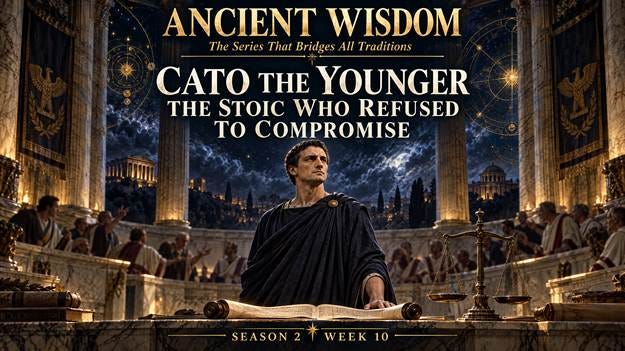
Marcus Porcius Cato, known as Cato the Younger, became Rome’s great symbol of this problem. He was a senator in the last decades of the Roman Republic, a serious student of Stoicism, and a relentless opponent of bribery, private ambition, and the concentration of power in a single man. An issue that is very prominent today … unfortunately.
Cato has often been remembered as the Stoic who would not bend. Cato’s public integrity was remarkable. His resistance to Caesar was noteworthy. He believed that a republic could not survive if law, offices, and public resources became instruments of individual power. He was also capable of severity, anger, political obstruction, and choices that remain difficult to defend. His life offers no easy permission to call every refusal principled.
So, Cato, forces us to ask a more exact question than, “Am I being flexible?”, such as “What would this agreement make me betray?”
Refusal is not automatically a virtue
There is a form of refusal that is little more than vanity…
It appears when a person treats every concession as humiliation. They cannot revise a mistaken view, because they have confused being right with being admirable. Every disagreement becomes an injury to the self. What appears to be principle, is in reality an appetite for control.
Stoicism won’t praise that condition, it is not interested to preserve an image of being unyielding. Once again, the main goal is to use judgment well.
A refusal becomes morally serious when it protects something that should not be sold, such as an obligation to tell the truth, a duty to deal fairly, a boundary against harm, a public trust, or the dignity of another person. And even then, the person who is refusing has work to do. They must name what is at stake and distinguish fear from duty. They must also accept the cost of saying no without turning that cost into a … theatre.
Cato made this discipline public. He did not retire to private moral purity, instead he brought his convictions into courts, elections, financial administration, the Senate, and eventually a civil war. Too far you would say …
The Roman Republic of Cato’s lifetime was marked by widening inequality, competition among elite families, debt, bribery, political violence, military commands, and contests over who could control the state. The old institutions still existed, but they were under extraordinary pressure.
Cato saw that pressure as a moral and political crisis. He feared that Rome was learning to accept what it should have found intolerable.
A Roman trained by Stoicism
Cato was born in 95 BCE and entered public life in a Rome already accustomed to political emergency. The fullest ancient account of his life comes from Plutarch, who wrote much later. Plutarch was a Greek biographer, and although his scenes need careful handling, his portrait preserves an important part of the historical record.
According to Plutarch, Cato studied with Antipater of Tyre, a Stoic philosopher, and devoted himself particularly to ethics and politics. Plutarch says that the form of goodness that attracted him most, was rigid justice that did not bend to favour.
The word rigid should make us pause for a moment. It appear to name Cato’s strength and his danger in the same breath.
For Cato, Stoicism was a way to enter it without being bought by it. He adopted a deliberately simple manner of life, cultivated endurance, learned to regard public rank and private wealth as less important than moral worth and he tried to carry that standard into the institutions through which Rome governed itself.
Cicero gives a complementary image in De Finibus. He finds Cato seated in a library surrounded by books on Stoicism. Cato, Cicero says, had such an appetite for reading that he would study while waiting for the Senate to convene, without taking attention from public business.
You see, Cato is not presented as choosing philosophy instead of public responsibility. He is shown carrying philosophical study to the edge of public action. In other words, he was really into it …
When Cicero lets Cato explain Stoic ethics, the argument is pretty simple, moral worth is the sole good. Wealth, office, popularity, safety, and victory may matter in practical deliberation, but none makes a person good merely by being possessed.
This did not mean that Cato thought all external outcomes were equal. Stoic ethics would not ask a senator to treat corruption and honest administration as interchangeable nor to refuse the easy mistake of calling success itself virtue.
For Cato, the public service was a testing ground, a way to remain just while influence, fear, faction, and public appetite pressed upon them. A touch task.
The uncompromising voice in the Senate
Cato’s most famous early intervention came during the Catilinarian crisis of 63 BCE.
A conspiracy associated with Catiline had shaken Rome. Senators debated the fate of captured conspirators. Sallust, who wrote a history of the episode, gives speeches to both Caesar and Cato. Ancient historians did not produce modern transcripts, so these speeches are shaped literary constructions, but they still reveal the kind of political argument later Romans associated with each man.
Sallust’s Caesar argues for a penalty of execution. Sallust’s Cato answers that the Senate must think first about protecting the state, not about finding elegant language for danger.
“Once a city has been taken,” Cato says in Sallust’s account, “nothing is left to the vanquished.”
This line is powerful because it identifies a real political failure. A society can become so preoccupied with procedure, appearances, or private comfort that it cannot recognize a threat until its ability to act has already disappeared.
Cato then turns on the senators themselves. He accuses them of valuing houses, villas, statues, and pleasures above their country. He sees private luxury growing beside public weakness and men who call greed generosity and recklessness courage because the honest names would indict their conduct.
There is something deeply Stoic in this diagnosis. Cato sees political collapse not only in laws and armies but in disordered judgment. A community becomes vulnerable when its leaders cannot distinguish what is useful from what is honorable, or what is popular from what is right.
But the episode also exposes the limits of admiring Cato too quickly.
His proposed answer was the execution of Roman citizens without ordinary trial. Such a decision was legally and morally contested, even in antiquity. It should not be turned into a general lesson that strong leadership means punishing hard and asking questions later.
Cato’s strength in the scene is his refusal to sentimentalize a grave threat. But his weakness is the risk that emergency can make severity feel self justifying. A person can be right that danger is real and still be wrong about what justice permits in response.
This is a lesson worth keeping close, because integrity is not proven by intensity. The more serious the crisis, the more carefully courage must remain answerable to law, evidence, proportion, and the people who will bear the consequences.
Cato and Caesar: the question was power
Cato’s conflict with Julius Caesar is often reduced to a clash of temperament, but it goes beyond that. Yes, Caesar was flexible, brilliant, generous, and ambitious and Cato was severe, austere, and difficult. There is truth in the contrast, but it can also hide the question that was most important to Cato.
Who should be allowed to hold power, by what limits, and for whose benefit?
Cato feared that Rome’s institutions were becoming tools for exceptional individuals. He opposed Caesar’s rise, but he was not blind to the risk presented by Pompey either. He had resisted Pompey’s exceptional commands before the civil war. When the conflict with Caesar became unavoidable, he joined Pompey’s side because he judged Caesar’s advance on Rome to be a more immediate threat to the Republic.
This is important, since it corrects the legend of a man who never made any adjustment. Cato did make strategic judgments and he chose among bad alternatives. He did not confuse moral seriousness with the fantasy that every situation offers a clean option. This would be unrealistic
Plutarch records one episode that captures the ground of Cato’s resistance. After Caesar’s campaigns in Gaul, Cato urged that Caesar be handed over to the peoples he had wronged in alleged violation of a truce. The proposal was extraordinary but also politically impossible. Yet its logic was clear: a successful general does not receive a moral exemption from the laws that restrain Roman conduct.
In a culture where victory could transform a commander into a public idol, Cato insisted on an older and harder rule:
Achievement does not cancel accountability
This is a lesson for every government and every institution, because each one has its version of Caesar’s problem. A person may be talented, productive, influential, wealthy, or admired and their success may bring real benefits. But none of this should give them a private constitution. None of it permits them to treat colleagues, commitments, or rules as obstacles made for other people.
Cato’s question remains useful:
What are we excusing because the person is successful?
The difference between a line and a wall

Cato’s example becomes dangerous when it is simplified into one instruction: never compromise. No serious political or personal life can survive on that rule …
That line protects something specific, it marks the point beyond which an agreement would require dishonesty, betrayal, cruelty, corruption, or abandonment of a real responsibility. On the other hand a wall is different, it keeps out criticism, negotiation, correction, and human complexity. A line can defend justice but a wall can defend pride.
Cato did not always keep this distinction clear though. Modern historians debate how much his obstructionist tactics contributed to the collapse he hoped to prevent. Some argue that his devotion to Rome’s ancestral customs mattered more to him than Stoic philosophy. Others point to contemporary evidence from Cicero showing that he was genuinely associated with Stoicism and brought philosophical argument into public life.
The debate does not of course reduce Cato to an inconsistency, but it reveals the difficulty of translating philosophy into institutions.
Cato could see the corruption of public life with unusual clarity. He could also treat accommodation as more dangerous than it was. He could resist the rise of personal power while lacking a political method capable of preserving the Republic. Even a morally serious person can identify a real danger and still misjudge the most effective response.
We should use this as a reason to dismiss principle as impractical. It would be more efficient to ask principle to become more intelligent!
Before refusing an agreement, a Stoic should ask:
What exact good does this refusal protect?
Is there a version of the proposal that preserves that good?
Who will pay the cost if I make this a public battle?
Am I refusing an injustice, or am I refusing the discomfort of not getting my way?
These questions make it more responsible.
The final refusal at Utica
After Pompey’s defeat and the collapse of the Republican cause in Africa, Cato was in Utica where he helped organize the departure of people who could escape. When Caesar’s victory became certain, Cato chose to die rather than live under the new order.
Later Stoics, especially Seneca, treated Cato as an image of moral freedom under overwhelming external loss. In On Providence, Seneca imagines him standing upright amid the ruins of the commonwealth. Seneca is shaping Cato into a philosophical exemplar.
Cato’s death was an irreversible act in a civil war and it should not be romanticized, copied, or treated as a general answer to defeat, political disappointment, or loss. Do not take Ancient Roman ideas about honor, freedom, defeat, and political order as instructions for modern private life.
External defeat does not automatically compel moral surrender. A person can lose office, status, safety, influence, reputation, or a public contest without giving up the capacity to judge, speak truthfully, care for others, and refuse corruption.
Cato’s final hours, as Plutarch tells them, included concern for the safety of those around him. You see, even at the end of his political world, the question of responsibility to others remained.
The Stoic lesson we get today, is to preserve moral agency when circumstances are no longer favorable.
What cannot be sold
Cato does not allow us to admire integrity as a pleasant personality trait.
Integrity is costly and it can cost promotion, access, approval, comfort, a coalition, or the image of being easy to work with. And it worth it. Because if it never costs anything, it may simply be a preference that has never met pressure. Everything is tested when it meets with pressure, everything in life.
However, cost alone does not make a refusal noble. We can pay dearly for a mistake, we can sacrifice relationships to preserve a false self image and we can also create a crisis because certainty feels safer than listening.
The Stoic discipline is clarity about value.
There are of course matters where negotiation is wise. Everything can change, from a plan to a role to a timeline. But we can learn from criticism without losing our character.
There are also other matters where agreement would make us participants in what we know is wrong. Misusing money, concealing misconduct, or choosing lie over truth to gain something. Cato pointed us to identify that difference before the pressure arrives.
Each one of us should know which duties they will not abandon in exchange for comfort, praise, security, or access. They should know the difference between a negotiable preference and a moral boundary. And they should be humble enough to test whether their refusal serves justice or merely serves the self.
The Stoic who refuses to compromise is is the one who knows what cannot be sold without losing the right to call their conduct good.
To the battle with honour and integrity!
By Dr Ioannis Syrigos
References
Plutarch. Life of Cato the Younger. Bernadotte Perrin translation. LacusCurtius. https://penelope.uchicago.edu/Thayer/E/Roman/Texts/Plutarch/Lives/Cato_Minor*.html
Sallust. The War with Catiline. J. C. Rolfe translation. LacusCurtius. https://penelope.uchicago.edu/Thayer/e/roman/texts/sallust/bellum_catilinae*.html
Cicero. De Finibus Bonorum et Malorum, Book III. H. Rackham translation. LacusCurtius. https://penelope.uchicago.edu/Thayer/E/Roman/Texts/Cicero/de_Finibus/3*.html
Seneca. Of Providence. Aubrey Stewart translation. Wikisource. https://en.wikisource.org/wiki/Of_Providence
Morrell, Kit. “Cato the Younger: life and death at the end of the Roman republic.” Bryn Mawr Classical Review, 2021. https://bmcr.brynmawr.edu/2021/2021.02.05/
Halper, Mary Elizabeth. “Cato the Younger: Roman Citizen.” Law and Liberty, 2020.
Encyclopaedia Britannica. “Marcus Porcius Cato.”