

Estimated reading time: 10 minutes
What an enslaved Stoic philosopher can teach us about the one territory no circumstance should be allowed to occupy: our judgement.?
Today, the word “freedom”, can often have so many definitions that it loses its impact. For example, people talk about “financial freedom,” “freedom to move,” “freedom from bad jobs,” and so on. Are any of these “freedoms” really all that important? Are they all really “free” from danger? After all, the market may change and affect us; the government can create restrictions on us; a medical condition may beat or restrict our physical body.
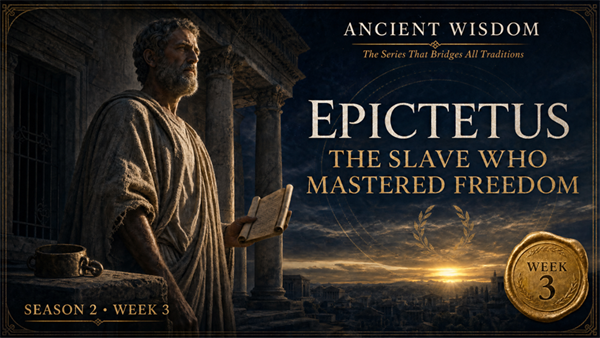
Epictetus, a Stoic philosopher from Greece, began his journey into philosophy in a manner that could be considered being at the bottom of the “vulnerability” ladder. Epictetus was born around 55 CE in Hierapolis (now Izmir), Greece (located in western Turkey today) and was eventually enslaved in Rome to Epaphroditus (the administrator for Emperor Nero). He later gained his freedom, learned the teachings of the Stoic philosopher Musonius Rufus, and opened a school in Nicopolis (now located in northern Greece). All that we know of his teachings today is through the writings of his student Arrian, who published them in two forms: The Discourses and the much shorter Encheiridion (Handbook).
It is interesting to note how many Masters from the past were written about by others, usually their students, instead of writing about themselves..
While the above facts are quite tempting to create a comforting fable-like story about a slave who finds out he was already free and that the cruelty of the world around him did not matter, it is simply not true that this is what happened. By suggesting this is how Epictetus found out he was free, we would be betraying both history and philosophy.
Enslavement is not a state of mind; it is the result of coercion, violence, sales, separation from family, and the legal dominion of one human being over another. Furthermore, Epictetus’s teachings do not negate the significance of these realities, nor do they imply that the oppressed have merely ignored their ability to think freely.
Instead, what Epictetus provides, is something much more difficult to articulate, yet much more exact: whilst everyone ultimately possesses their freedom externally, each individual must address the question, at least once, of:
what they will judge, desire, refuse, and do with the portion of themselves that will always remain unique to them and not subject to any other person, group, institution, or circumstance.
In Epictetus’s view, this question marks the beginning of an individual’s freedom.
The freedom no one can hand you
The Greek term prohairesis, means the ability to make moral choices, and is at the centre of Epictetus’ philosophy. Prohairesis means to consciously choose something before you act on it. It allows humans to assess impressions and determine whether or not to agree with them, as well as make a decision and direct their desires.
This is not to be confused with the common expression “have a positive attitude.” Prohairesis represents the centre of your judgement. Epictetus provides an initial basis for understanding the term in his Handbook (Encheiridion):
“There are things we can control and those we cannot. Things we can control are opinions, pursuits, desires, aversions (and all other actions) that we create through prohairesis. Things out of our control are such things as the body, possessions, reputation, what others have given, taken, praised, or destroyed.”
- Encheiridion 1.
One could easily misinterpret this statement as advising one to not care about anyone or anything. Epictetus does not advise one to give up the pursuit of one’s body, possessions, or other attributes of public life. Rather, he is telling one to stop confusing the importance of these attributes with the only way in which one can act with or without integrity.
Prohairesis is the point where freedom begins and excuses stop.
Although an event may not have been chosen by the individual and may not have led to a desired outcome, one still has the power to determine the outcome of one’s actions.
A philosopher made under constraint
A few details about Epictetus’s life during the early years are missing from the available records; however, we know the origins of Epictetus’s limp, which is the result of an injury, The most credible evidence about Epictetus’s limp comes from Ancient Roman and Greek sources which identify more than likely, two potential sources for it: either arthritis or (most possible) physical assault while being enslaved.
The importance of not filling in Epictetus’s background is because it does not need embellishment, as his philosophy is radical enough as it is, since he placed moral freedom as the central part of his life and teachings (in contrast to status, safety, or wealth). In Book I of the Discourses, Epictetus imagines the most severe threat a man can create, ‘I will put you in chains.’
Clarity is one reason why Epictetus defined his answer carefully; chains limit one’s movement, but do not definitively exert control over one’s will. Of course Epictetus does not imply that imprisonment is not terrible. Instead, his response denies that physical coercion overrides our ability to use our minds.
That distinction is uncomfortable because it does not flatter us… and today we love flattering. Although we all have more freedom of movement than Epictetus did, we often abdicate our judgement by surrendering to other people’s negative comments, or by giving power over ourselves to an angry email or the imaginary views of others regarding us and our decisions. All of them are fear factors, such as the fear of looking foolish, the need to be admired, the anxiety of a result not yet known.
We call this being realistic. Epictetus calls it a form of servitude.
The first discipline is to challenge the appearance
The first time we see an event in our minds is called an “appearance”. The facial expression of the manager, the assessment of something, the void of silence generated from receiving something, the headline in a newspaper, and the thought that comes to us at 3:00 am all create an “appearance”. These “appearances” can be correct, incorrect, partial, or manipulated/controlled. We do not have complete control over how these “appearances” will occur. Our responses to an “appearance” constitute the beginning of our contributions to it.
Epictetus made a suggestion in his Encheiridion dated 135 AD that is simple to understand:
“Work, therefore to be able to say to every harsh appearance, You are but an appearance, and not absolutely the thing you appear to be.”
This is not an instruction to disregard what is real but rather a directive to slow down our reaction to what we perceive as harsh and jump to a conclusion.
Suppose we see our colleague remain quiet; what is the appearance? We might conclude, “They think I’m worthless”; that’s our conclusion based on our interpretation. If we see that there was a sudden rise in the cost of something we expected to buy, then the appearance is “my life has been ruined” or “my financial future has been ruined.” Again, that is our conclusion based upon how we interpreted what we observed.
When looking at these levels of appearance on paper, there appears to be a little difference, yet in times of difficulty, they are the “total” difference from choice to reaction.
When making any decision, always identify the appearance that you observed. Next, determine how supporting evidence exists to the story you have constructed. If evidence is minimal, you haven’t accomplished anything, however, you have created some “wiggle room” to approach the situation rather than just fleeing from it.

The second discipline is to stop demanding guarantees
The next step is more of a challenge. When we see an incident partly out of our control, we tend to spend time worrying about it. We mentally “play the tape” of our conversation over and over, imagining every possible future catastrophe, and exhausting ourselves mentally thinking that if only we could work hard enough, we could make things happen as we want them to.
Epictetus taught that what is ours and what does not belong to us can be determined by two questions: “What is mine?” and “What is not mine and what is permitted and what is not permitted to me?”. These questions seem passive until we really use them to help us figure out what belongs to us.
You cannot determine whether an application has been accepted, but you can determine whether what you submitted was of high quality with integrity. You cannot control how loyal someone else will be to you, but you can determine how honest you communicate with them, how much you look at the evidence presented, and what boundaries are yours to set. You cannot control how others will misrepresents you, but you can determine whether you respond to those misrepresentations truthfully or with the same misrepresentation.
This is not a belief that will lessen your ambition; it is an ambition that allows you to free yourself from the bondage of using it to determine your worth. You may work hard for your goal, but your worth does not depend upon achieving it. You may have strong feelings for a person, but your mind does not have to constantly focus on his or her choice, blocking everything else from your life’s journey. You can stand up against injustice, but hatred does not have to dictate how you choose to stand up against it.
Epictetus instructed his students to pursue and avoid things “gently and simply and with a lightness of touch.” What this means is not to be lukewarm, It means without the desperate inner contract that says: If this does not happen exactly as I require, I cannot remain whole.
The third discipline is to do not sell yourself cheaply
Epictetus teaches his students about two kinds of “buying into” something:
(1) moral; (2) economical.
Every day, external things make an offer. Approval asks you to soften a truth you know should be spoken. Comfort asks you to delay a responsibility you can already see. Status asks you to become more performative, more evasive, or more cruel. Fear asks you to call inaction prudence. Anger asks you to call retaliation justice.
Epictetus does not pretend that these choices are costless. Sometimes saying no will cost an opportunity, a friendship, or a place in the room. However, he insists that the more important calculation comes first: What is this choice making of me? This is the aspect of Stoicism most alien to a culture of constant optimisation. We are trained to ask whether a choice is efficient, profitable, strategic, visible, or safe. Epictetus asks whether it preserves the faculty by which we choose at all. He is not interested in a heroic identity. He is interested in the daily practice of remaining someone who can still recognise truth when it is inconvenient.
Freedom is not withdrawal from other people
The distorted understanding of Stoicism as an emotional quarantine from the world (i.e. keep distance, mistrust, need nothing, and then label this isolation as independence) is not what was taught by Epictetus.
Epictetus provides an alternative view; he clearly understands humankind through its roles (e.g., child, parent, neighbour, citizen, friend, etc.). Freedom in order to fulfil these roles without giving up our egos is part of the purpose for the discipline of freedom. Because freedom IS a form of discipline. A parent who has control over every outcome is not acting lovingly. A friend who requires continual affirmation or reassurance is not free. A public servant who views reputation as the most important good cannot serve justly.
Therefore, freedom from compulsive judgement does not mean that we withdraw from our duties, but more accurately that we establish the foundation upon which we can act responsibly. The more we become devoid of our need for the world to affirm our private story, the more accurately we can see the needs of others, the harm done to a community and our own responsibilities.
For this reason, Epictetus’s teachings are still highly relevant today in organizations where there are high levels of risk for wrongdoing. Epictetus is not instructing us to tolerate injustice, abuse, and corruption. Instead, he is instructing us to understand what is actually happening, differentiate our feelings from the evidence, and select the appropriate response without becoming the same to that which we oppose.
The freedom audit
Epictetus’s philosophy is not complete when it is admired. It only becomes real when it interrupts a choice.
When a situation begins to dominate your mind, pause and write four lines.
Objectively, what happened (no exaggeration)
What story am I telling about the situation?
What is the difference between my own responsibility, authority and jurisdiction about this event, and who and what else is involved that is not mine to command?
What Action shall I take to maintain my integrity, even if the result is not what I want.
This exercise can be done within three minutes and, if used regularly, will have a major impact on the way we think, as well as keep our imagination from interfering with our ability to think clearly about our judgement.
Ultimately, we cannot achieve a permanent state of freedom from fears, pleasures, resentments and/or approvals through an understanding of what outside sources can offer. Rather, Epictetus describes the pursuit of freedom as a training process and he recommends that we develop this skill through practice. That includes the initial writing of the event, as well as reviewing, rehearsing and correcting.
Epictetus did not master freedom by controlling the world around him. He mastered it by refusing to let the world dictate the value of his own moral choices. The lesson is not that external freedom does not matter. On the contrary, it matters profoundly and we need to fight for it. The lesson is that without an inner freedom capable of examining appearances, no external condition will ever be enough to keep us from becoming servants of fear.
By Dr Ioannis Syrigos
References
Graver, Margaret. “Epictetus.” Stanford Encyclopedia of Philosophy, substantive revision 2025. https://plato.stanford.edu/entries/epictetus/
Epictetus. Discourses, Book 1. Translated by George Long. Internet Classics Archive. https://classics.mit.edu/Epictetus/discourses.1.one.html
Epictetus. Encheiridion. Translated by Elizabeth Carter. Internet Classics Archive. https://classics.mit.edu/Epictetus/epicench.htmll