

Estimated reading time: 14 minutes
Memento mori is among the best known phrases attached to Stoicism. It appears on rings, posters, notebooks, and social media feeds. It is often presented as a severe Roman command: remember that you will die.
The phrase is useful, but the history needs a correction. Memento mori is a later Latin formulation, not exactly a Stoic technical slogan. Epictetus and Marcus Aurelius wrote in Greek. The surviving Senecan passages on death do not use those words. The popular story that a servant whispered the phrase to every victorious Roman general is not secure evidence for its Stoic origin either.
Yet the correction does not weaken the practice. It makes it even more interesting!
Obviously, the Roman Stoics did not need a slogan to make mortality central to their philosophy ... They repeatedly returned to death, time, change, loss, and the limits of possession. They did so to make human attachment seem foolish. They used mortality awareness to ask a harder question:
if time is not promised, what becomes worthy of attention now?
For them, remembering death was a discipline of clearer living. It exposed the cost of postponement. It challenged the fantasy that other people belong to us and it reduced the power of status and trivial conflict. It also made a person focus on the next act that could still be chosen with justice, courage, and affection.
This distinction matters, because death awareness is easily misunderstood. It can sound like fatalism or be confused with emotional numbness and it can even be used to dismiss grief, or even worse, to make life seem disposable. None of that applies to the Stoic tradition.
The Stoic invitation is more demanding and more humane:
Remember finitude, so that you stop casually postponing what love, courage, and responsibility require.
The phrase is later. The practice is ancient.
Mortality was a constant influence on peoples’ lives in the Ancient World; From Roman banquets where they served meals with little skeleton-esque decorations to schools of thought that were founded in Philosophy (though it didn’t stop with the Philosophers). Mortality was something that was viewed by many different schools of thought (e.g. Stoics, Epicureans, and others) and was incorporated into their beliefs and practices. For example, Seneca actually reported that Epicurus said to “remember to die.”
But it is important not to turn this broad tradition into a false quotation. Memento mori does not appear as a Stoic motto in the texts of Epictetus, Seneca, or Marcus Aurelius. The label came later. It gathered together themes that were already present in Greek and Roman reflection, then acquired a long afterlife in Christian art, devotional practice, and modern culture.
When creating a slogan like Memento mori to express Stoicism, we do not need to create a belief that by repeating Memento mori over and over again we will somehow be healed of our fear of death. Stoicism was designed to help us learn to face our fears, to prepare us to deal with future changes, to recover today from the past, and ultimately to have healthy relationships with people based on their uncertainty, rather than their guaranteed ability to die first.
The phrase Memento mori can be a useful reminder of Stoicism, as long as we remember that “doorway” does not mean “house.”
“Indifferent” does not mean that nothing matters
Stoic language creates another difficulty. The school classifies death as neither a moral good nor a moral evil in itself. In the technical vocabulary of Stoic ethics, death is an “indifferent.”
Using this language can come across as cold or cruel when, in fact, it does not imply that dying does not hurt, that losing someone does not hurt, or that it has no effect on the people that were close to them. Death, as defined by the Stoics is a claim about what makes a human being morally better or worse.
Furthermore, Stoics viewed virtue and vice as the most important factors when determining what defines a good or bad person. To be virtuous means to have courage, justice, honesty, self-control, and care for others; these virtues define a person’s character, while death, health, wealth, fame, and current conditions are not, in themselves, what make a person good or bad. They matter deeply in ordinary human life, but they do not have the final power to determine whether a person acts nobly or shamefully.
This distinction may be difficult for people because it eliminates the two gratifying simplifications. It refuses the idea that a painful event is morally good simply because it happened. It also refuses the idea that an external loss can automatically destroy every possibility of acting with dignity.
You can suffer grief and still love. You can be ill and still be honest. You can lose time, position, or security and still choose to be brave. This is the position of Stoicism.
An awareness of our own mortality starts from this point, not from a hatred of life but from the understanding that life is temporary and, therefore, morally the most meaningful relative to the time we are given.
Epictetus: Separate the event from the verdict
Epictetus places the work of death awareness in the discipline of judgment.
In his book Enchiridion, Epictetus provides the foundation of stoicism regarding death. He asserts that death itself is not an evil, but rather one inflicts evil upon themselves via the mental judgment of death.
Epictetus is not telling a bereaved person that loss should feel painless. He is just making a technical claim about terror and moral evaluation. Because fear often arrives with a verdict already attached: This must not happen. I cannot bear this. My life will be ruined. Nothing good can remain. The Stoic practice simply asks our mind to notice that the event and the verdict are not identical.
In a passage from the Discourses recorded by Arrian, Epictetus conducts an austere exercise. “Your son is dead,” he says. “What has happened? Your son is dead. Nothing more? Nothing.”
The severity of the line must not be hidden. It is meant to interrupt the added conclusion that the bereaved person has therefore become morally ruined or that life has become worthless. It is not a denial of the bond, the absence, or the grief. It is an attempt to locate the part of human life that sorrow does not have to destroy: the capacity to act with integrity, to care, and to continue meeting duties.
This is obviously not a simple practice, and it is certainly not a command to suppress your feelings. It only asks for precision at the moment when fear begins to speak as if it were the whole and only truth.
That same precision appears in Epictetus’s direct instruction on a daily reflection. “Let death and exile, and all other things which appear terrible be daily before your eyes,” he writes, “but chiefly death.” The purpose, he says, is meant to prevent abject thought and excessive craving.
The logic is clear, isn’t it?
A person who remembers that time, possessions, recognition, and even relationships cannot be possessed without limit may become less desperate to control them.
The practice can make vanity look smaller, ordinary kindness to feel less postponable and it can reveal how much life is being spent preparing to live later.
Epictetus calls philosophy preparation for what comes upon us. Death awareness belongs to that preparation and it is a refusal to be caught wholly unprepared by a truth that was never hidden.
Impermanence can deepen gratitude without making loss easy
Epictetus’ remarks regarding our loved ones, are often difficult for the modern reader to comprehend. He tells the student to remember, when embracing a child or spouse, that the person is mortal. Other times, he says to think not “I have lost it,” but “I have returned it.”
A good reader will not interpret these two instructions as prohibitions against loving or grieving for someone. In fact, both are just very strict lessons about non-possession. In both instances, Epictetus challenges the reader’s desire to consider someone as a permanent possession and/or that love has conditioned the other person to be in the same state of permanence as that possession.
What Epictetus was trying to teach us was not that love or attachment is bad, but that possession is an illusion.
When we remember that we do not own a relationship, this presents us with a unique ethical opportunity; we are likely to be more present and less attached to our loved ones. We may also become able to hear others without assumptions. We can speak our truth to others and we will feel empowered to share our lives with them while we are still alive, rather than waiting on the perfect time to do it.
Gratitude, from this perspective, does not demand that we feel happy about our losses. Loss can remain devastating and grief can remain real. Mortality awareness does not ask a person to be grateful for pain but it asks whether the fact of impermanence can make care more attentive while the person, conversation, or day is still here.
In conclusion, the ethical approach, based on the knowledge of mortality, would be to allow this experience to encourage us to continue to be more present with and less attached from those we love or will eventually lose.
Seneca: We are dying daily because time is already passing
Seneca’s approach begins with the experience of time slipping away.
In the opening letter to Lucilius, he asks, “Who understands that he is dying daily?” The question is not theatrical. Seneca means that the years behind us are already beyond our possession. Time does not begin to matter only when illness, age, or catastrophe comes. It is important because each day has already become part of a life that cannot be retrieved.
This is why Seneca treats postponement as a moral problem. The busy person believes life will begin after the project, the promotion, the conflict, the improvement, or the next period of stability. But the period of waiting becomes life itself.
In On the Shortness of Life, Seneca observes that many people spend their days preparing to live. They guard their money, reputation, and calendar with care while allowing their attention to be taken by trivial demands. Then they imagine that the important conversation, the worthwhile work, or the considered life can begin at some time in the future.
Mortality awareness interrupts this thinking! It asks, not “What if I die tomorrow?” but “What has the assumption of endless tomorrow allowed me to postpone today?”
The answer does not need to be dramatic. It needs to be an honest conversation. For example, it might be time given to someone who has become an item on a list. It might be a task that has been delayed because it asks for courage rather than convenience. Or it might be a quiet hour without distraction, spent examining whether the life being built actually reflects the values being praised.
Seneca’s death awareness does not make every day a frantic final performance, that would be exhausting! In Letter 61, he says he is trying to live each day as a complete life. This phrase means that a day should not be made meaningless by being treated only as a corridor toward some imagined future that may or may never arrive ….
A complete day can include unfinished work as well as uncertainty and ordinary obligations. What makes it complete is that the person has not abandoned the present entirely to anxiety about what has not yet arrived.
Seneca’s important refusal
In his letters, Seneca warns against turning awareness of death into a love of death. In Letter 24, he emphasizes that a person must be strengthened for both Life and Death; the idea of ‘the balance between Life and Death’ should be taken seriously. Seneca says a person should not love Life too much or hate Life too much; he admonishes against what he calls “The Lust for Death.”
As such, a modern interpretation of Stoicism will only be complete if we understand that the awareness of Death does not glamorize it, purify it or make it attractive; it does not provide a means to escape the ordinary sufferings of existence. It does not provide a solution to grief, trauma or severe emotional distress. Ancient philosophy cannot replace the kindness and compassion of the support of a fellow human or the experience of a professional when an individual is overwhelmed.
Seneca describes a ‘servile fear’ of Death; when a person views Death as the ultimate evil, they will also develop an inordinate vulnerability to all forms of threat, humiliation, and the pressure to conform. A person who wishes to pursue Death as an object of desire has simply inverted an obsession. Neither of these poles results in freedom.
The Stoic path is steadier than that. Death is to be accepted as a part of the human condition when it occurs; during the time between one’s Death and one’s Birth, to live one’s Life with courage and without evasion.
Marcus Aurelius: Cosmic scale, immediate duty
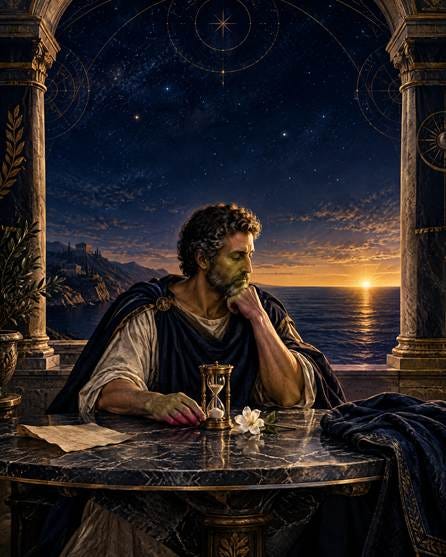
Marcus Aurelius returns to mortality again and again in his private notes (we call today the Meditations). His reflections move between two scales, as it would be with every human being.
At one scale, he looks outward. Asia and Europe, he writes, are corners of the universe. The sea is a drop. The present time is a point in eternity. Generations rise and vanish. Fame is brief. Even the people who remember us will soon be gone.
The passage can sound bleak if it is read alone, but Marcus uses it to put vanity in proportion. What becomes smaller under the larger view is the anxious need to be admired, the resentment over trifles, and the fantasy that status can make a life secure.
At another scale, Marcus looks closely at the next act. In Meditations 2.5, he tells himself to do each act as if it were the last. The surrounding language is important and the act should be carried out with dignity, affection, freedom, justice, and rational self command.
This is the Stoic form of death awareness at its most practical. The awareness that time is finite directs us toward the quality of the thing immediately before us.
Can the next conversation be more honest?
Can the next decision be less ruled by vanity?
Can the next obligation be met without complaint?
Can the next act of care be offered before it becomes a regret?
Marcus describes death as an operation of nature. The phrase belongs to a Stoic view of the world as a whole of change and transformation. He is not claiming that every death is morally good, or that loss is painless, or that people should become passive before injustice. He repeatedly insists on cooperation, gentleness, truth, and service to others. The cosmic scale is a way of removing the distractions that keep us from particular duties. Isn’t it something similar that astronauts said when they saw Earth from space? It puts things into perspective…
The universe may be vast but the person in front of you still needs your kindness.
What the practice can offer, and what it cannot
Practice of one’s own mortality may bring perspective on a day-to-day basis. That practice may evoke a sense of urgency and purposefulness that we may not have been aware of in the past, allowing us to break the cycle of the never-ending desire for more, by producing a sense of responsibility towards action in the present. Furthermore, it may also allow us greater opportunity to appreciate those we may have taken for granted; when we realize we cannot predict the future, nor do we know how long we will be surrounded by those we care about, it creates a greater understanding for these people in our lives.
However, there are certainly limitations to this practice. It will not erase the pain of loss, nor will it remove the mental anguish one suffers as a result of losing a loved one, nor will it bring peace, eliminate worries about the future, or provide a permanent support system when life becomes overwhelming. What the Stoic philosophers offer, is an insight into how to “think” through a given issue or situation, rather than providing any actual source of comfort when dealing with loss.
This distinction is important because creating an awareness of our mortality should create more appreciation for the present and less for the future. If, as you reflect upon your mortality, it becomes too much for you to handle, do not attempt to force yourself. It might be better for you to put aside your contemplation and seek out a trusted friend or family member for help in making sense of your experience. Stoic thinking is not about carrying a burden alone. It is important to get help and benefit from the experiences of others.
The one possible way to develop an awareness of your own mortality in a very simple way, is to stop and think about how we postpone enjoyable activities simply because we feel there is always a tomorrow to enjoy those activities. You could think about how when we treat our relationships as something that can always wait until tomorrow, you might see the importance of that relationship more clearly if you have only six months to live than if you feel you have 60 years. Perhaps you could consider the duties that you have today versus the duties you will need to perform tomorrow.
So, do not let fear, anxiety, or panic take over your ability to live life to its fullest. Use the opportunity and ability to live your life honestly and with integrity with the choices you make.
When you have completed your day and have lived your life the way you wanted to live it, you may be able to look back and appreciate those people you have allowed to enter your life.
Remember finitude, then live more faithfully
The later phrase memento mori has survived because it names a real human need. We need reminders that time is not an unlimited resource, that bodies change, that people are not possessions, and that delay can become a way of refusing life.
The Stoics gave that reminder a demanding moral shape. Epictetus asked for clarity about the judgment added to fear, Seneca asked for a day that is not sacrificed entirely to expectation and Marcus, like a modern astronaut, asked for justice and affection in the next act, even under the scale of the cosmos.
None of them asks us to become cold. None of them asks us to despise life. The most careful Stoic version of death awareness says the opposite.
Because life is not infinite, love should not be postponed. The future is uncertain and courage should not wait for perfect conditions. Remember that every reputation fades, truth and kindness deserve more of our attention than vanity. And at the end, because loss is real, presence is not trivial.
Remembering death is a way to stop spending a meaningful life as if it were guaranteed.
By Dr Ioannis Syrigos
References
Epictetus. The Enchiridion. Elizabeth Carter translation. Internet Classics Archive. https://classics.mit.edu/Epictetus/epicench.html
Arrian, recording Epictetus. The Discourses, Book 3. George Long translation. Internet Classics Archive. https://classics.mit.edu/Epictetus/discourses.3.three.html
Seneca. Moral Letters to Lucilius, Letters 1, 24, and 61. Richard Mott Gummere translation. Wikisource. https://en.wikisource.org/wiki/Moral_letters_to_Lucilius/Letter_1 https://en.wikisource.org/wiki/Moral_letters_to_Lucilius/Letter_24 https://en.wikisource.org/wiki/Moral_letters_to_Lucilius/Letter_61
Seneca. On the Shortness of Life, Chapters VII through IX. John W. Basore translation. Wikisource. https://en.wikisource.org/wiki/On_the_shortness_of_life
Marcus Aurelius. Meditations, Books 2, 6, and 9. George Long translation. Internet Classics Archive. https://classics.mit.edu/Antoninus/meditations.2.two.html https://classics.mit.edu/Antoninus/meditations.6.six.html https://classics.mit.edu/Antoninus/meditations.9.nine.html
Diogenes Laertius. Lives of Eminent Philosophers, Book 7. Attalus. https://www.attalus.org/old/diogenes7b.html
“Memento Mori.” Oxford Reference. https://www.oxfordreference.com/display/10.1093/oi/authority.20110803100149356
Durand, Martin. “Stoicism.” Stanford Encyclopedia of Philosophy. https://plato.stanford.edu/entries/stoicism/