


Estimated reading time: 16 minutes
For sure money can pay for food, safety, education, care, time, and the ability to help another person. Nobody doubts that. We also know that status can open doors, command attention, and enlarge the reach of useful work. And it is not for the sake of statues, it is because you worked hard to achieve it. And then success can create room to build, provide, repair, and serve.
The Stoics knew this. They were not naïve about the uses of wealth or the consequences of rank.
Yet today, Stoicism is often presented as if it required a simple choice. Either money is corrupting and the wise person should reject it, or money is a reward for disciplined thinking and the wise person should accumulate it without apology. However, both readings miss the point!
The central Stoic question is unrelated to money, status, and public success. The question, as with anything, is whether they make a human being good or bad.
For the Stoics and for most of rational people, the answer is no. Wealth cannot make an unjust person just, an office cannot make a vain person wise, public praise cannot make a coward courageous and poverty, obscurity, or failure cannot by themselves make anyone virtuous.
And please do not take this distinction as an argument for withdrawing from ordinary life. It is a simple argument for placing ordinary life in the right order. Money, recognition, influence, health, and security can be worth choosing as long as they are used with intelligence and care. But, even then, they remain external conditions. They are materials for judgment and unrelated to your moral worth.
This is a demanding position, isn’t it? It tells the person who has little that lack is not a verdict on character and it also tells the person who has much that possession is not proof of character. And for everyone else, the ethical question begins after acquisition as much as before. The question is, what are these resources making possible, and what are they making of us?
The false choice between worship and renunciation
Our modern life creates a constant pressure to turn visible success into an identity, and here is the mistake. Income, title, followers, prestige, influence, and possessions appear as evidence that a life is advancing. But is it? Because at the same time, another performance waits nearby … the performance of being above all ambition, untouched by practical need and proud of needing nothing.
BOTH are just performances … and the Stoics refused both of them as such ...
Their own tradition makes the question impossible to avoid, isn’t it? Because, Seneca was a wealthy senator and adviser at Nero’s court. Epictetus began life in slavery and later taught philosophy in exile. Marcus Aurelius was emperor of Rome! Their circumstances were radically different, but they had something in common, as all of us have:
How can someone use external advantages without making them the measure of freedom, dignity, or happiness?
And the answer begins with a distinction that it can initially sound strange until its purpose becomes clear.
Early Stoic doctrine classifies wealth, fair fame, and noble birth among things that are neither morally good nor morally evil in themselves. Diogenes Laertius, reporting the school’s teaching, includes wealth, health, reputation, and their opposites in this category. And it is as true today as it was in the past.
Another word often used for this category is … “indifferent”, and it is one of the most misunderstood words in Stoicism.
We need to distinguish between Indifferent and irrelevant. It does not mean that health, food, housing, money, safety, family, or social standing have no practical consequences. It also does not mean that a person facing poverty or exclusion should be told that nothing important has happened!
What it really means, is that these things do not settle the deepest ethical question:
Whether a person is using judgment, courage, justice, and self command well.
Thus the Stoics made a further distinction. Some externals are normally preferable. Wealth is clearly preferable to poverty, health is preferable to illness, safety is preferable to danger and a good reputation may have practical value. I do not think that any of us would disagree with that … So let’s called them preferred “indifferents”, which will be a useful label later on, for the Stoic distinction.
Cicero’s account of Stoic theory simplifies the practical reason for that. If every external condition were treated as exactly equal in choice, then ordinary life would collapse into confusion, right? A person would have absolutely no reason to seek health over sickness, security over danger, or resources over deprivation. That would be totally unrealistic. So, Stoic ethics do not abolish practical judgment, instead it gives practical judgment a second rank.
A preferred external is worth choosing when it can be chosen in a just way. And it is not what makes the chooser worthy.
This single distinction, separates Stoicism from both success worship and theatrical renunciation.
Wealth is useful and It is not the good.
The reason Seneca returns to money so often, is because wealth has a special power to disguise itself as the “good life”.
Why? Because it can undeniably reduce hardship, increase choice, protect a family from shocks, provide education, leisure, treatment, travel, and the ability to give. And exactly because it can do so much, it can be easily mistaken for the thing that makes all other things worthwhile.
Seneca objects to this mistake, but not to every use of money.
In Letter 87, he says that “riches shower upon us a semblance of the good”. The phrase is exact: Wealth resembles the good because it can look like security, freedom, admiration, and power. But resemblance is not identity, right?
A person of poor character can possess money, a person with money can be fearful, dishonest, arrogant, cruel, or enslaved by comparison. Wealth can therefore be useful, but without being morally good in itself.
Seneca’s makes the (true) point that rich people sometimes behave badly. What is genuinely good should consistently benefit the person who possesses it. And wealth does not ... It may be used with courage and generosity, or with vanity and injustice, because it can serve either character, it is a tool and therefore it cannot by itself be the source of character.
This is why Seneca distinguishes an advantage from a good. Because an advantage may have more usefulness than harm. But a good, in the strict Stoic sense, must be unmixed. And while virtue meets that test, wealth does not.
By doing this distinction, the Stoic say two things at once without contradiction. That money may be worth pursuing and money is not worth becoming morally dependent upon.
When possession becomes servitude
Seneca’s most memorable warning is psychological. “He who needs riches least,” he writes, “enjoys riches most.” The person who craves wealth, he says, ceases to be master and becomes a steward.
This is the Stoic counterpart of the biblical “You cannot serve God and mammon”, which is not a denial of wealth, it is a refusal to be wealth’s slave.
So it is not an attack on saving, planning, building a business, or providing for dependents. It only describes the moment when the owner begins serving the possession, and this is where the mistake and the darkness lies.
The signs must be familiar to all of ue. More is never enough because each increase creates a new standard and because of that you cannot enjoy what has been earned since attention is consumed by protecting it, displaying it, comparing it, or fearing its loss. And while a promotion produces relief for a week, then becomes the floor beneath the next demand. The income rises, but the mind becomes more dependent on the next rise. I have been there and I am sure most of you have been there too …
Money itself does not cause this condition. Seneca, in Letter 17, he says, “the fault is not in the wealth, but in the mind itself.” The same restless desire that makes poverty unbearable can make abundance feel inadequate. The two sides of the pendulum.
This is why Stoic simplicity is not a performance of looking poor. Seneca’s phrase is clear: “If you wish to have leisure for your mind, either be a poor man, or resemble a poor man”. But the point is voluntary sufficiency, that is the person with resources should be able to live without constant luxury, display, and dependence on excess.
And we need to make a distinction clear … Voluntary simplicity is not the same as involuntary deprivation…
A person without secure housing, health care, food, safety, or economic choice is not receiving a spiritual lesson from poverty. And stoicism does not make hardship beautiful just because it exists… Seneca himself makes a suggestion that should stand beside every sentence about austerity:
it is better “to mitigate poverty, and to relieve wealth of its arrogance.”
The Stoic target is the belief that no amount of security can ever be enough unless it becomes a guarantee of personal worth.
Enough is not the same as much
Seneca’s Letter 119 asks a question that remains difficult in every age:
“Would you rather have much, or enough?”
Enough changes with circumstance. For example, a parent responsible for children, a person managing illness, someone caring for an aging relative, or an individual living with financial insecurity, has real reasons to seek more resources.
Seneca’s question targets the logic of limitless craving. The person who has much but must always have more has not reached sufficiency. On the other hand, the person who knows what is enough has a stopping point.
This is why money can fail to make someone rich in the ethical sense. Yes it enlarges the capacity to acquire, but it may also enlarge the appetite for acquisition. It can create an entire life organized around protecting an image of success that can never be completed.
The Stoic alternative is to ask ambition to state its purpose.
Does the next financial step provide for a real need? Does it create time, security, knowledge, or capacity for useful work? Does it permit generosity? Or is it mainly an effort to avoid the discomfort of feeling ordinary beside people who have more?
The answer may not always be clear, but the question interrupts a powerful habit:
treating accumulation as self justification.
Status is a role, not a self
Money is only one form of external success. Status on the other hand, can be even more intoxicating because it arrives through other people’s recognition. And most humans crave that … we are social beings after all.
A title, office, award, institution, audience, family name, or public following they do have real utility, because they can help a person persuade, lead, protect, teach, fund, or organize. We cannot deny that. What the Stoics denied, is that borrowed prestige becomes the moral excellence of the person who possesses it.
Epictetus offers a sharp image for that, if someone owns a beautiful horse, he says, the beauty belongs to the horse, the owner is foolish to treat the horse’s excellence as his own. Let’s extend this analogy. A prestigious role may be real, a successful company may be real, an admired title may be real, but NONE of them automatically becomes evidence of the holder’s wisdom, courage, or justice.
In the Enchiridion, Epictetus includes property, reputation, and command among the things that are not fully ours. This of course does not mean we have no influence over them, because we do most of the times. What it means is that they depend partly on fortune, institutions, markets, other people, and circumstances beyond personal choice and they cannot provide a secure foundation for freedom.
In the Discourses, he asks a socially powerful man whether he is truly free. The man lists his credentials: free born parents, senatorial rank, friendship with Caesar, a consulship, and many enslaved people. Epictetus does not deny the social reality of those advantages, he only asks whether the man is still compelled by fear, appetite, money, or the favor of powerful people.
“Is not money your master?” Epictetus asks elsewhere.
This question works as a diagnosis of dependence. Money becomes a master when a person will betray judgment, relationships, or justice rather than risk losing it ... Similarly, status becomes a master when someone will flatter, conceal, or injure others rather than lose the appearance of importance.
This is why Epictetus can speak of the poor person, the governor, and the private person in the same breath. None of these roles determines the quality of the soul, each creates a different field of duty.
So the governor must govern justly, the employee must act honestly, the parent must care for a child and the citizen must consider the common life. Nonattachment to a title does not mean to neglect the responsibilities attached to it.
Recognition has utility but Applause has no authority
Marcus Aurelius knew the pressure of status from inside the highest office in the Roman world. He was an Emperor and not many have been in such a position in the history of humanity.
So, he did not solve it by pretending that office was worthless. In Book 1 of the Meditations, he praises Antoninus Pius for managing public expenditure carefully, attending to the common good, and using the supplies of fortune without arrogance. Antoninus could use abundance when it was present and refrain from craving it when it was absent.
That is exactly the Stoic model of external success. Use the resource but DO NOT worship it. Administer the role but DO NOT become the role.
Marcus is especially alert to praise when he asks, “What is praise, except indeed so far as it has a certain utility?” Reputation can sometimes assist us, it may make a leader more trusted, a teacher more heard, or an institution more capable of acting.
But praise does not make something good. An emerald does not become more valuable because people applaud it, neither does justice become just because it is admired, nor does vanity become wise because it is rewarded.
Marcus calls applause “clapping of tongues”. By that he means that public approval is unstable, often poorly informed, and easily confused with truth. A person who treats applause as the source of worth gives other people the power to define the value of a life, right?
What is the alternative? It is certainly not private self congratulation. It is a more demanding measure of success. In Meditations 11, Marcus asks:
“Have I done something for the general interest? Well then I have had my reward.”
This does not mean outcomes never matter. Feeding people, administering institutions, building useful work, and correcting injustice all involve external results. Marcus’s point is that a person can work seriously for those results without making personal credit the reward.
The useful question is not simply, “Did I win?” It is also, “Was the effort just? Was it honest? Did it serve the common interest? Did I remain capable of acting well if recognition did not arrive?”
Ambition without self worship
Stoicism is not a philosophy of staying small to avoid envy, risk, or responsibility.
Marcus begins one of his best known reflections by telling himself that he is rising “to the work of a human being”. He contrasts actions that concern society with the intense labor people willingly give to money and glory. His challenge is that they may work tirelessly for external reward while treating service, justice, and fellowship as lesser concerns.
There is a different kind of ambition.
It can seek a demanding role, build expertise, earn resources, lead an organization, persuade others, improve an institution, or deliver a public good. But it does not make possession of the result the condition of self respect.
Marcus calls this acting with reservation. Work for the just result, use reason, persistence, and courage, but remember that outcomes can be blocked by other people, material limits, timing, illness, and fortune. This means that a failed effort is not automatically a moral failure, nor is every successful effort a moral success.
This distinction protects action from two equal errors. One is passivity disguised as acceptance and the other is outcome worship disguised as ambition.
A Stoic says:
“I will try fully for what justice and duty require, but I will not make my moral standing depend on a result I cannot guarantee.”
There is no promise here that discipline will produce wealth, prominence, or influence. Stoicism offers something harder: the possibility of working without handing over one’s freedom to the scoreboard.
Money as a social responsibility
The Stoic view of money becomes most demanding when money can be shared.
Seneca’s On Benefits does an inquiry into giving, receiving, obligation, gratitude, and power. He argues that gold, silver, office, and honor are not themselves benefits. The moral value of a gift lies in the goodwill and judgment of the giver.
Obviously, a kind intention cannot replace material help. A person who needs food, treatment, secure shelter, education, or protection needs real resources. Goodwill without adequate assistance can become a flattering story that the giver tells about themselves.
Seneca’s point is subtler. The same transfer of money can have a different moral meaning depending on how it is given. It can meet a need with respect. It can advertise the donor. It can purchase access, gratitude, silence, or loyalty. It can preserve another person’s agency, or it can create a dependency that the donor enjoys controlling.
The Stoic question is therefore not only how much someone gives. It is whether the giving is wise, proportionate, timely, respectful, and free of domination.
Seneca says that a person should help someone in need “yet so that I do not want myself.” Generosity requires judgment about resources, responsibilities, the recipient’s situation, and the scale of assistance. This is not permission for selfish caution. You need to refuse to treat self destruction or performative sacrifice as the only form of moral seriousness.
A good gift does not make the recipient a permanent stage on which the giver performs importance.
Cicero, writing in a Roman Stoic moral tradition, makes a similar point about wealth. Money may supply necessities, influence, and the means to bestow favors, but unjust acquisition must be avoided.
The Stoic ideal is an unbought capacity to use resources for human good without turning aid into a private monument.
Seneca and Marcus: the test cases are not simple
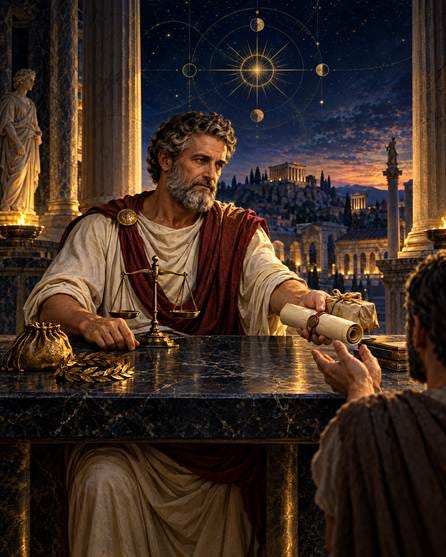
It is reasonable to ask whether Seneca’s own wealth undermines his criticism of wealth.
It is also reasonable to ask whether an emperor can credibly warn against status worship.
These biographies do create tension, and for a good reason. However, they should not be dismissed.
Seneca’s proximity to imperial power, his wealth, and his participation in Rome’s elite world make his attacks on luxury, greed, and display more difficult and not less. His writing may not solve every historical question about his conduct, but it provide a standard by which his conduct can be judged: wealth should remain in the house and not in the heart; it should be used without arrogance, fear, or injustice; it should never become an excuse for moral exemption.
Seneca is not presented in his own letters as a person who has made every external pressure disappear. In Letter 87, he admits embarrassment when traveling with inadequate equipment. This is important because it shows the stoic discipline that exposes the gap between what a person says and what their reactions reveal.
Marcus offers a different test. His authority was immense and yet he warns himself not to become “Caesarified.” The ancient phrase is specific to empire, but its meaning is familiar today too ... A role can begin as a duty and become an identity that changes its holder in a bad way. Authority can become a color that stains every judgment.
Marcus praises the public administration of Antoninus precisely because it is sober, responsible, and free from the hunger for display. Office becomes morally demanding because it enlarges both the opportunity to serve and the opportunity to dominate.
The lives of Seneca and Marcus show why the doctrine is difficult. It is just that money and rank make the moral task more visible.
Success as stewardship
The Stoic view of money, status, and external success is not an excuse to avoid success, and it is also not permission to worship it.
Money is a resource, reputation has practical utility, office is a field of service and achievement can provide the means to protect, teach, build, employ, support, and give.
But none of these things can make a corrupt person good or guarantee freedom or permanently secure the admiration of others. And also none can relieve a person of the duty to ask how it was acquired, used, or what it costs others, and whether it can be relinquished without the loss of self.
The Stoic audit is therefore:
What am I calling success: a resource for a worthwhile life, or evidence that I deserve one?
What duties come with my money, position, visibility, or expertise?
Is my next financial or professional step just in its acquisition and honest in its presentation?
Would the loss of this title, audience, income level, or possession be painful without becoming a verdict on my character?
When I give, am I meeting a real need in a way that preserves another person’s agency, or am I buying deference and a flattering image of myself?
These are questions designed to make achievement answerable.
The Stoic ideal is to be owned by nothing that can be bought, praised, granted, or taken away.
Onwards and upwards!
By Dr Ioannis Syrigos
References
Diogenes Laertius. Lives of the Eminent Philosophers, Book VII. Robert Drew Hicks translation. LacusCurtius. https://penelope.uchicago.edu/Thayer/E/Roman/Texts/Diogenes_Laertius/Lives_of_the_Eminent_Philosophers/7/Zeno*.html
Cicero. De Finibus Bonorum et Malorum, Book III. H. Rackham translation. LacusCurtius. https://penelope.uchicago.edu/Thayer/E/Roman/Texts/Cicero/de_Finibus/3*.html
Cicero. De Officiis, Book I. Walter Miller translation. Project Gutenberg edition.
Epictetus. The Enchiridion. Elizabeth Carter translation. Internet Classics Archive. https://classics.mit.edu/Epictetus/epicench.html
Epictetus. The Discourses, Books 2, 3, and 4. Elizabeth Carter translation. Internet Classics Archive. https://classics.mit.edu/Epictetus/discourses.2.two.html https://classics.mit.edu/Epictetus/discourses.3.three.html https://classics.mit.edu/Epictetus/discourses.4.four.html
Seneca. Moral Letters to Lucilius, Letters 14, 17, 20, 87, 115, and 119. Richard Mott Gummere translation. Wikisource. https://en.wikisource.org/wiki/Moral_letters_to_Lucilius/Letter_14 https://en.wikisource.org/wiki/Moral_letters_to_Lucilius/Letter_17 https://en.wikisource.org/wiki/Moral_letters_to_Lucilius/Letter_20 https://en.wikisource.org/wiki/Moral_letters_to_Lucilius/Letter_87 https://en.wikisource.org/wiki/Moral_letters_to_Lucilius/Letter_115 https://en.wikisource.org/wiki/Moral_letters_to_Lucilius/Letter_119
Seneca. On Benefits, Books I and II. Aubrey Stewart translation. Wikisource. https://en.wikisource.org/wiki/On_Benefits/Book_I https://en.wikisource.org/wiki/On_Benefits/Book_II
Marcus Aurelius. Meditations, Books 1, 5, 6, and 11. George Long translation. Internet Classics Archive. https://classics.mit.edu/Antoninus/meditations.1.one.html https://readaurelius.org/book/5 https://classics.mit.edu/Antoninus/meditations.6.six.html https://classics.mit.edu/Antoninus/meditations.11.eleven.html
Durand, Martin. “Stoicism.” Stanford Encyclopedia of Philosophy. https://plato.stanford.edu/entries/stoicism/
Kamtekar, Rachel. “Marcus Aurelius.” Stanford Encyclopedia of Philosophy.